Simplemente te casas con un alemán y ya tienes tu residencia: Verbal violence, interactive positioning, and the stereotype of the opportunistic marriage migrant in Latin American migration contexts in Germany
DOI:
https://doi.org/10.18716/ojs/the_mouth.11980Abstract
This contribution focuses on the role of gender stereotypes in the emergence of verbal violence. Drawing upon selected examples from the VIOLIN corpus, a collection of narratives of problematic communicative encounters by Latin American migrants residing in Germany, we apply a combination of Narrative Analysis and Positioning Theory in order to elucidate how the perception of verbal violence can emerge from a sense of being unfairly positioned by members of the mainstream society. For this purpose, we use the stereotype of the “opportunistic female marriage migrant” as a case example. This widespread stereotype, prevalent in both German and many Latin American societies, suggests that women from economically-disadvantaged countries take advantage of their German husbands to secure residency and a better life. As emerges from our analysis, Latin American women often find themselves being positioned as “opportunistic marriage migrants”, but vehemently reject such positioning in their narratives. However, they still tend to reassert and perpetuate the stereotype by using it as a foil to construct their own positions as honest, well-educated and independent, and thus as members of a distinct, and morally superior, category of migrant women in Germany.
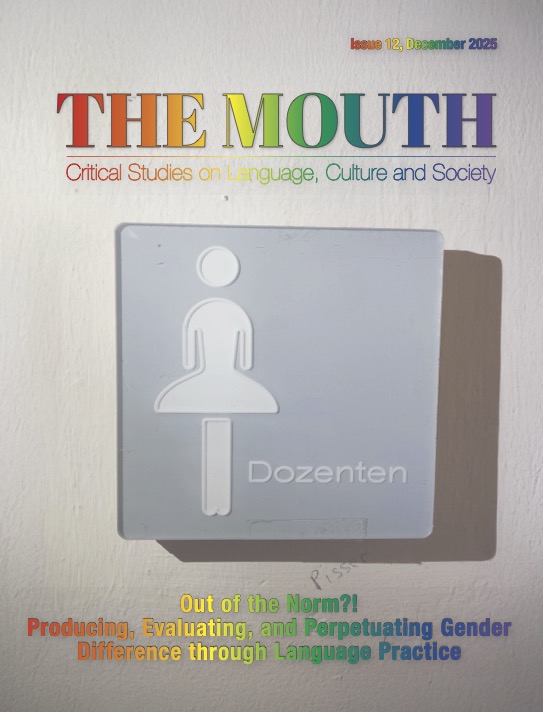
Downloads
Published
Issue
Section
License

This work is licensed under a Creative Commons Attribution 4.0 International License.
CC BY 4.0 deed
https://creativecommons.org/licenses/by/4.0/deed.en
You are free to:
- Share — copy and redistribute the material in any medium or format for any purpose, even commercially.
- Adapt — remix, transform, and build upon the material for any purpose, even commercially.
- The licensor cannot revoke these freedoms as long as you follow the license terms.
Under the following terms:
- Attribution — You must give appropriate credit , provide a link to the license, and indicate if changes were made . You may do so in any reasonable manner, but not in any way that suggests the licensor endorses you or your use.
- No additional restrictions — You may not apply legal terms or technological measures that legally restrict others from doing anything the license permits.
Notices:
You do not have to comply with the license for elements of the material in the public domain or where your use is permitted by an applicable exception or limitation .
No warranties are given. The license may not give you all of the permissions necessary for your intended use. For example, other rights such as publicity, privacy, or moral rights may limit how you use the material.Notice
This deed highlights only some of the key features and terms of the actual license. It is not a license and has no legal value. You should carefully review all of the terms and conditions of the actual license before using the licensed material.
Creative Commons is not a law firm and does not provide legal services. Distributing, displaying, or linking to this deed or the license that it summarizes does not create a lawyer-client or any other relationship.
Creative Commons is the nonprofit behind the open licenses and other legal tools that allow creators to share their work. Our legal tools are free to use.